Why Organisational Change Really Gets Stuck: Four Sectors, One Common Pattern
Why do organisational changes fail? Discover how LEGO® SERIOUS PLAY® helps teams uncover hidden systems that shape behaviour and create lasting organisational change.

Over the past six months, we have facilitated LEGO® SERIOUS PLAY® (LSP) workshops across a wide range of organisations—from telecommunications companies and financial institutions to international conferences and other organisations. The industries, organisational cultures, teams and workshop objectives varied significantly, from strengthening collaboration and reimagining the future role of trainers to exploring career development and leading organisational change.
Despite these differences, participants consistently arrived at the same conclusion: people are rarely the real barrier to change. The real barrier is the system in which they operate.
In this article, we share the key insights and reflections that emerged through hands-on modelling and facilitated dialogue about systems and organisational change.
Why Do We Say One Thing but Build Another?
The first models created in almost every workshop revealed similar assumptions. Participants initially believed that poor collaboration, resistance to change or disappointing results were mainly caused by factors at the individual or team level:
- Lack of trust
- Insufficient communication
- Low motivation
However, the deeper the conversations became, the less participants focused on individual characteristics and the more systemic issues emerged:
- Unclear roles and responsibilities
- Different understandings of the shared goal
- Rigid bureaucracy
- Information that fails to reach the right people at the right time
At the end of one workshop, participants summarised it perfectly. Their key recommendation was not "people need to be more motivated" but rather:
"Start with a shared vision and role clarity—who does what, how and in what sequence."
The same pattern emerged even in workshops that were not directly about collaboration.
For example, when participants explored the future role of trainers, they did not begin by discussing systems. Instead, they talked about identity, purpose and meaning. Yet even there, the same structural pattern appeared: the trainer of the future is no longer the centre of the system but an important connector that links people, technology and different learning environments.
Even on a personal level, when workshops focused on careers and envisioning an ideal future, the same principle emerged. Participants did not see a lack of motivation as the main obstacle. Instead, they identified concrete structural factors—unclear transition points and environments that either enable or hinder movement towards where they truly want to go.
What Happens When We Talk About Change Through the Lens of Systems?
In one workshop dedicated entirely to analysing organisational change through a systems perspective, this pattern became particularly clear.
Participants first built models of changes they had personally tried to implement. They then created models of the systems that either supported or prevented those changes.
Three insights appeared consistently:
- Change is social.
- Change requires learning.
- Systems shape behaviour.
Why Does This Insight Repeat Across Different Sectors?
This is not a coincidence. It is exactly what behavioural science predicts.
According to the COM-B model, behaviour is not driven by motivation alone. Capability and Opportunity are equally important. In other words, does the system actually allow people to behave in the way the organisation expects?
If an organisation wants stronger collaboration but rewards only individual performance, it does not have a motivation problem.
If it expects greater initiative while punishing mistakes, it does not have a courage problem.
The system is simply producing exactly the behaviour it was designed to produce.
As quality management pioneer W. Edwards Deming famously argued, the vast majority of organisational problems originate from the system itself rather than from the people within it.
Our workshop experience confirms the same principle: resistance itself is rarely the problem. The problem lies in the system that creates that resistance.
This also explains why the same pattern emerged across such different contexts. Whether working with a telecommunications company, a bank, an international conference or an internal learning and development team, the structural dynamics shaping human behaviour were remarkably similar.
What Does This Mean for Your Organisation?
If change has stalled in your organisation, it may be worth asking a different question before commissioning another training programme:
What in our system is currently producing exactly the behaviour we don't want?
In practice, this usually comes down to three things.
1. Create clarity around roles and responsibilities
Uncertainty about who is responsible for what appeared repeatedly, regardless of whether participants were discussing teamwork, career development or the future of their organisation.
2. Understand the system before trying to fix it
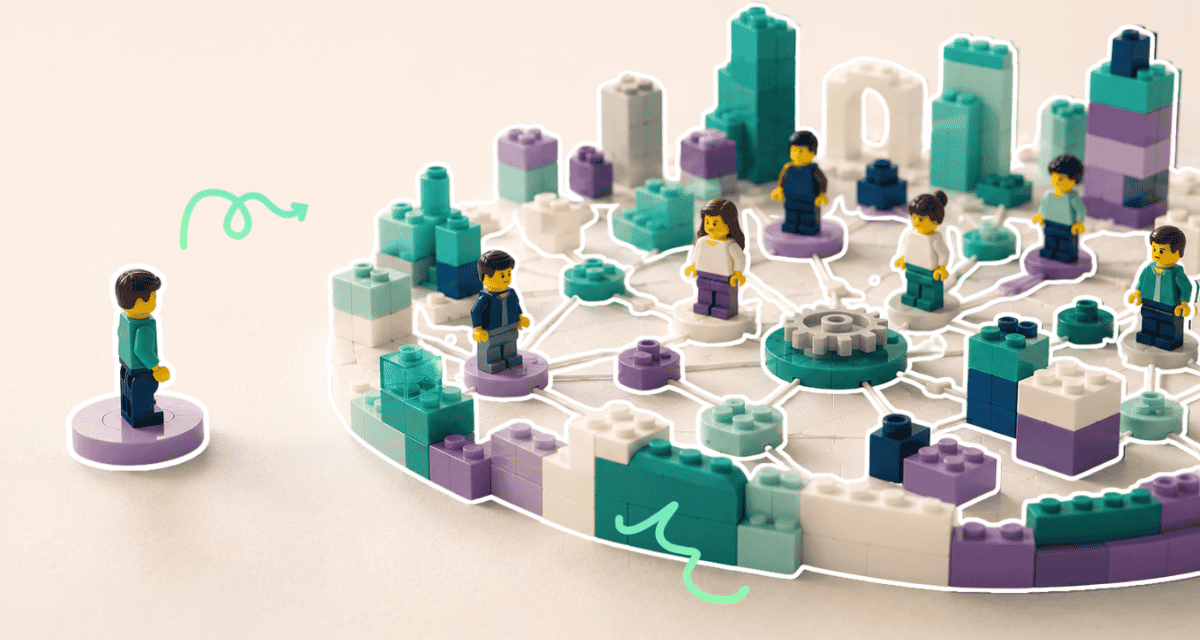
LEGO® SERIOUS PLAY® models do not tell people what to do. Instead, they make visible what is actually happening within the system. That visibility needs to come before selecting the right intervention—not afterwards.
3. Change the system, not just people's behaviour
In one workshop, we asked participants:
"What is the one small change in the system that could create the biggest shift in behaviour?"
More often than not, this question proved far more powerful than designing another large-scale change programme.
In Summary
Different organisations. Different objectives. The same underlying pattern.
Change rarely fails because people are unwilling.
It fails because the systems shaping their behaviour have not yet been examined closely enough.
LEGO® SERIOUS PLAY® is much more than an engaging workshop method. It is a powerful facilitation approach that helps organisations make invisible systems visible. And once the real problem becomes visible, meaningful and lasting change becomes possible.
Is Your Organisation Facing a Change That Looks Good on Paper but Isn't Taking Hold in Practice?
LEGO® SERIOUS PLAY® helps uncover the systemic patterns that are truly influencing organisational behaviour. Get in touch at helena@mindshifters.ee, and let's explore together where your change really begins.